Feeds:
Posts
Comments

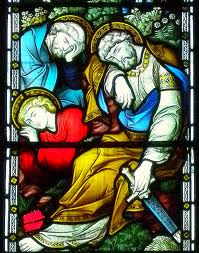
And he cometh unto the disciples, and findeth them asleep, and saith unto Peter, What, could ye not watch with me one hour? – Jesus (Matthew 26:40)

How did Jesus handle the failures of his disciples? Sometimes with chiding and other times with teaching but always with mercy, grace, and understanding.

We see Jesus on his worst day needing his friends — but they just weren’t there for him. Far from rejecting them, he understood and later sent them out to change the world!

We fail, too. We fall asleep when we should be alert, we mess things up and sometimes do short-term damage to his causes, yet he understands. He sometimes chides our conscience, other times he sends us to relearn a lesson or two, but through it all he is tender, kind and understanding.

Like with his first disciples, he knows our failures are not final – he has his purposes for us, still.

What lessons have you learned of the tenderness of Christ for our failures?

– fritz@langgang.com

Use Your Imagination!

[W]e look not at the things which are seen, but at the things which are not seen: for the things which are seen are temporal; but the things which are not seen are eternal. – 2nd Corinthians 4:18

How does God expect us to see something that can’t be seen? We do it all the time when we read a book, talk to friends, hear a lecture, even when daydreaming – how do you think we do that? We use our imagination!

Visualizing in the mind and heart what is desired (or feared) but not seen, is a gift of God. Though it has been abused and misused it can be brought back into captivity to Christ (2nd Corinthians 10:4-6) and used for its intended purpose – to enable us to anticipate, endure, and prepare for what time and space prevents us from seeing right now. Because it is imagined doesn’t mean it is false, it can be more true than what we think we see!

Begin using godly imagination to “see” what God says is all around us – his care, his kingdom, his promises. You could start here:

[Y]e are come unto mount Sion, and unto the city of the living God, the heavenly Jerusalem, and to an innumerable company of angels,

To the general assembly and church of the firstborn, which are written in heaven, and to God the Judge of all, and to the spirits of just men made perfect,

And to Jesus the mediator of the new covenant, and to the blood of sprinkling, that speaketh better things than that of Abel. – Hebrews 12:21-24

Visualize the throne, see the city, see the church and the people and the angels, and Jesus. Imagine yourself there – what would you say, what would you do? Start using your imagination to see what God says is there – it will be more accurate than the façade this world is offering.

– fritz@langgang.com

Ready or Not

[Jesus] went on to tell them a parable … “A man of noble birth went to a distant country to have himself appointed king and then to return … ‘Put this money to work,’ he said, ‘until I come back.’

“But his subjects hated him and sent a delegation after him to say, ‘We don’t want this man to be our king.’ “He was made king, however, and returned home.

Then he sent for the servants to whom he had given the money, in order to find out what they had gained with it.
…‘Sir, your mina has earned ten more.’ …“‘Well done, … take charge of ten cities.’
… ‘Sir, your mina has earned five more.’ …‘You take charge of five cities.’
… ‘Sir, here is your mina; I have kept it laid away in a piece of cloth…‘Take his mina away…
‘I tell you that to everyone who has, more will be given, but as for the one who has nothing, even what they have will be taken away.

But those enemies of mine who did not want me to be king over them—bring them here and kill them in front of me.’” – Luke 19:11-26

Jesus, like all preachers, reused sermon illustrations. But though there is a hint of previous sermons (the lesson of the servants and talents) there is a different ending and overall message.

This version was spoken as Jesus was facing the cross and in the story the future king faces opposition – some don’t want his rule and even some of his own think him cruel. But in the end he rules anyway, commanding those who opposed him to be judged at his feet.

Jesus point is that he shall return whether he is wanted or not, whether he is believed or not, whether we are ready or not – his rule shall ultimately happen and when he comes he will judge the lazy, the fearful, and those who resisted – but bless those who acted in faith.

Better to greet him as a friend than as an enemy!

– fritz@langgang.com