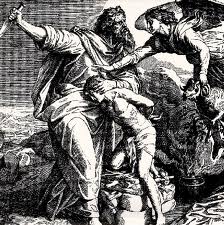
 Abraham …bound his son Isaac and laid him on the altar … But the angel of the LORD called out to him from heaven, “Abraham! Abraham!” … “Do not lay a hand on the boy,” … Abraham looked up and there in a thicket he saw a ram … and sacrificed it as a burnt offering instead of his son. – Genesis 22:9b-12-13 (NIV)
Why such a story like this in our Bible? A man being told to kill his son on an altar – the idea is repugnant to us today!
But human sacrifice was often demanded by the gods and religions of Abraham’s day. What could be more dear to a man than his only son, and what could show his devotion more than sacrificing that son on an altar.
But the God of the Bible is different; Abraham had to learn that and so do we. In this one event God established two (2) critical lessons:
- God doesn’t want human sacrifice like the other gods (demons) required. He’s not interested is us giving him some thing, no matter how dear, he wants us to give him ourselves.
- God institutes the concept of substitution. God, himself, provides the substitute – here it was a ram for a son, but later it would be Christ tasting death1 for us that we may go free.
So, how was the sacrifice of Christ NOT human sacrifice? Because it was Christ’s self-sacrifice. Jesus was not the victim2 but the instigator and voluntary participant. He was on a mission – not to satisfy some whim of a deity but to free mankind from the bondage of sin.
Charles Wesley, an Anglican priest, brother to John Wesley and co-founder of Methodism expressed it this way,
He breaks the power of canceled sin,
He sets the prisoner free;
His blood can make the foulest clean,
His blood availed for me.3
– fritz
1 – Hebrews 2:9
2 – John 10:17-18, Matthew 26:53
3 – Hymn, “Oh For A Thousand Tongues” by Charles Wesley
 I am enjoying today’s gadgets — an electronic Bible to hold as many versions as I want, including all my study notes, commentaries, with large enough print to read yet small enough to fit in my hand; a pen that can save every stroke (no more writing on Twinkie wrappers or paper napkins); a world-wide soap box (Blog).

